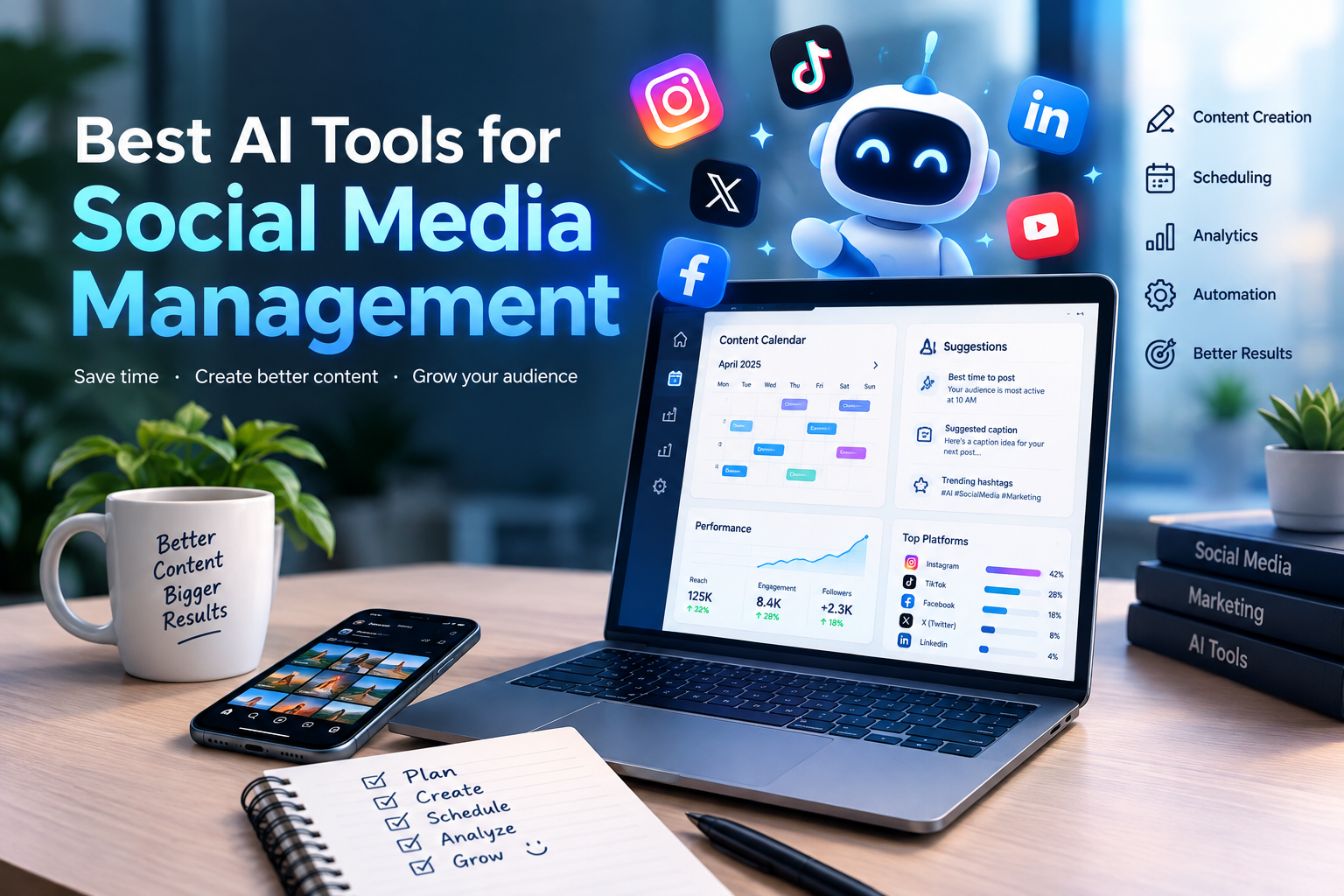
Managing social media as a small business owner means juggling content ideas, captions, images, scheduling and reporting, often between customers and deliveries. AI tools can take over the repetitive parts of that work. The right one saves hours each week. The wrong one adds another subscription and another dashboard to check.
This guide compares the best AI tools for social media management, explains what each one does well, and helps you choose based on how you actually work.
Quick answer: if you want one tool to schedule posts and get AI help with captions, start with Buffer or Hootsuite. If design is your bottleneck, add Canva. If you only need ideas and drafts, a general AI assistant like ChatGPT or Claude may be enough on its own.
What “AI social media management” actually means
Most tools in this category use AI for four jobs:
- Idea generation: suggesting topics, hooks and content calendars.
- Caption writing: drafting, shortening or rewriting posts for each platform.
- Design: creating images, resizing graphics and building templates.
- Scheduling and analytics: publishing at set times and showing what performs.
Few tools do all four well. That is why many small businesses combine two: a scheduler and a design tool, or a scheduler and a general AI assistant.
How we chose these tools
We compared tools on the factors that matter most to a small business owner:
- AI features: what the AI can really do (captions, ideas, repurposing, design).
- Platform coverage: support for Instagram, Facebook, LinkedIn, TikTok, X, Pinterest and others.
- Ease of use: how fast a non-expert can schedule a week of content.
- Pricing structure: free plans, per-channel pricing and what is locked behind higher tiers.
- Fit for small teams: collaboration, approvals and client access.
Features and plans change often, so confirm current details on each tool’s official site before you subscribe.
Quick comparison
| Tool | Best for | AI strength | Free plan |
|---|---|---|---|
| Buffer | Simple scheduling for solo owners | Caption help and idea assistance | Check current terms |
| Hootsuite | Larger accounts and multi-channel teams | AI caption writer, broad management | Check current terms |
| Later | Visual brands (Instagram, TikTok, Pinterest) | Visual planning and caption help | Check current terms |
| Canva | Designing posts and short videos | AI design and writing tools | Free version available |
| Sprout Social | Agencies and growing businesses | Analytics and reporting | Trial available |
| Metricool | Budget-friendly all-in-one | Scheduling plus analytics | Check current terms |
| ChatGPT / Claude | Ideas, captions and content calendars | Flexible writing and planning | Free tiers available |
1. Buffer: best for simple scheduling
Best for: solo owners and small teams who want an easy way to plan and publish posts.
Buffer is known for its clean interface. You connect your accounts, write or paste your content, and schedule it across platforms in a few clicks. Its AI assistant helps you generate ideas, rewrite posts and adapt one message for different networks.
Strengths
- Easy to learn, even if you have never used a scheduler.
- Helpful AI for drafting and repurposing captions.
- Clear calendar view for planning a week or month.
Limitations
- Fewer advanced analytics and team workflows than larger platforms.
- The AI helps with text but is not a full creative suite.
Our take: a strong first scheduler if your priority is simplicity and consistency.
2. Hootsuite: best for managing many channels
Best for: businesses that manage several accounts or need approval workflows.
Hootsuite is one of the most established social media management platforms. It combines scheduling, monitoring, analytics and team features. Its AI writing feature suggests captions and hashtags and helps you adapt tone.
Strengths
- Wide platform coverage and detailed management tools.
- Useful for teams that need permissions and approvals.
- Combines publishing with monitoring and reporting.
Limitations
- Can feel complex for a one-person business.
- Higher tiers are needed for advanced features.
Our take: worth considering if you manage multiple brands, locations or team members.
3. Later: best for visual brands
Best for: brands built around photos and video, such as restaurants, boutiques, salons and creators.
Later focuses on visual planning. You can see your Instagram grid before you post, organize your media library and schedule across visual platforms. AI features support caption writing and content suggestions.
Strengths
- Visual calendar and media library.
- Good fit for Instagram, TikTok and Pinterest workflows.
- Helpful for keeping a consistent look.
Limitations
- Less suited to text-heavy platforms.
- Some features depend on your plan.
Our take: a good match if your content is mostly images and short video.
4. Canva: best for creating the visuals
Best for: owners who struggle to design good-looking posts quickly.
Canva is a design tool more than a scheduler, but it earns a place here because visuals are where most small businesses lose time. You can start from templates, resize one design for several platforms, and use its AI features for image creation and text. It also includes scheduling for some platforms.
Strengths
- Thousands of templates for posts, stories and short videos.
- Brand kit to keep colors, fonts and logos consistent.
- Easy for non-designers.
Limitations
- Scheduling and analytics are limited compared with dedicated tools.
- Some AI and premium assets require a paid plan.
Our take: pair it with a scheduler for a simple, powerful setup.
5. Sprout Social: best for analytics and reporting
Best for: growing businesses and agencies that need to prove results.
Sprout Social is a premium platform with detailed reporting, a unified inbox and team tools. Its AI features assist with writing and engagement. It is more than most solo owners need, but it can be valuable when reporting to clients or stakeholders matters.
Strengths
- In-depth analytics and professional reports.
- Unified inbox for messages and comments.
- Strong collaboration features.
Limitations
- Priced for businesses, not beginners.
- More features than a small account will use.
Our take: consider it when social media becomes a core revenue channel or a client service.
6. Metricool: best budget-friendly all-in-one
Best for: owners who want scheduling, analytics and basic reporting without a high price.
Metricool combines planning, analytics and competitor tracking in one dashboard. Its AI tools help with caption suggestions and content ideas. It is often chosen by freelancers and small agencies looking for value.
Strengths
- Broad feature set at a more accessible price point.
- Analytics and scheduling in one place.
- Suitable for managing a few client accounts.
Limitations
- Interface can feel busy at first.
- Advanced features vary by plan.
Our take: a practical option if you want more than a basic scheduler without paying for an enterprise suite.
7. ChatGPT and Claude: best for ideas and content calendars
Best for: owners who want help with planning, hooks and captions without adding another platform.
General AI assistants are not social media tools, but many small businesses use them as the creative engine. You can ask for a 30-day content calendar, five caption variations or ways to repurpose one blog post into posts for each platform.
Strengths
- Highly flexible for ideas, captions, replies and scripts.
- Free tiers available, so you can start at no cost.
- Easy to adapt to your brand voice with a short style description.
Limitations
- No built-in scheduling or analytics.
- You need to give clear context to get non-generic results.
Our take: the cheapest way to start. Combine one with a free or low-cost scheduler.
Which tool should you choose?
| Your situation | Best choice |
|---|---|
| Solo owner, want it simple | Buffer |
| Multiple channels or team approvals | Hootsuite |
| Visual brand (food, retail, beauty) | Later + Canva |
| Design is your biggest time sink | Canva |
| Need client-ready reports | Sprout Social or Metricool |
| Minimal budget | ChatGPT or Claude + a free scheduler |
Example setups that work
The lean setup (low cost): an AI assistant for ideas and captions, plus a free scheduler. Plan once a week and publish consistently.
The visual setup: Canva for designs, Later for scheduling, and an AI assistant for caption variations.
The growth setup: Hootsuite or Sprout Social for management and reporting, with Canva for creative production.
How to use AI on social media without sounding robotic
- Start with your own input. Share a real detail, a customer story or a behind-the-scenes moment, then ask AI to shape it.
- Give the AI your voice. Paste two or three past posts you like and ask it to match the style.
- Edit before posting. Remove generic phrases and add specifics like names, places and prices.
- Adapt for each platform. A LinkedIn post and an Instagram caption should not be identical.
- Check facts and claims. AI can invent details. Verify anything specific before you publish.
- Keep a human in the replies. Customers notice when comments are automated or off.
Common mistakes to avoid
- Posting more instead of better. Consistency beats volume.
- Using the same caption everywhere. Each platform has its own style and audience.
- Ignoring analytics. Look at what drives clicks, saves and sales, and do more of it.
- Paying for too many tools. Start with one scheduler and one creative tool.
- Skipping disclosure rules. If you use sponsored content or affiliate links, follow platform and legal guidelines.
Frequently asked questions
What is the best free AI tool for social media management?
Canva offers a free version for design, and AI assistants like ChatGPT and Claude have free tiers for writing. Several schedulers offer limited free plans. Terms change, so check each site’s current offer.
Can AI manage my social media completely?
AI can draft, schedule and analyze, but it works best with human direction. Brand voice, timely replies and judgment calls still need you.
Is AI-generated content allowed on social platforms?
Generally yes, but platforms have rules about transparency, spam and misleading content. Some platforms ask you to label realistic AI-generated media. Review each platform’s current policies.
How much time can AI save on social media?
Most of the savings come from planning and drafting. Many owners reduce weekly content work noticeably by batching their posts in a single session.
Which platforms should a small business focus on?
Choose where your customers already spend time. Local service and retail businesses often do well on Facebook and Instagram; B2B services tend to favor LinkedIn.
Final verdict
You do not need a complex stack to manage social media well. Pick one scheduler you will actually open, add a design tool if visuals slow you down, and use an AI assistant to remove the blank-page problem. Test for a month, look at the results, and only then consider paying for more.
Leave a Reply